
Rialto Casino games, slots and jackpots
 Available in GB
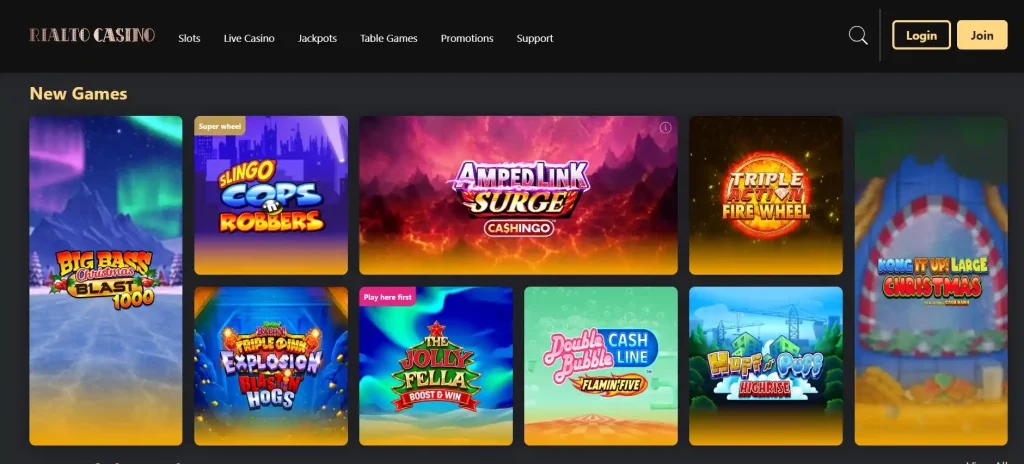
Rialto Casino brings together video and classic slots, Megaways-style games, jackpot titles, live table games and hosted game shows. The selection combines established software suppliers with distinctive live broadcasts connected to Grosvenor casino venues. The most useful way to examine the catalogue is to separate three decisions: the type of game, its individual rules and mathematical return, and the pace at which a session can run. A large menu of titles does not make every game behave alike.
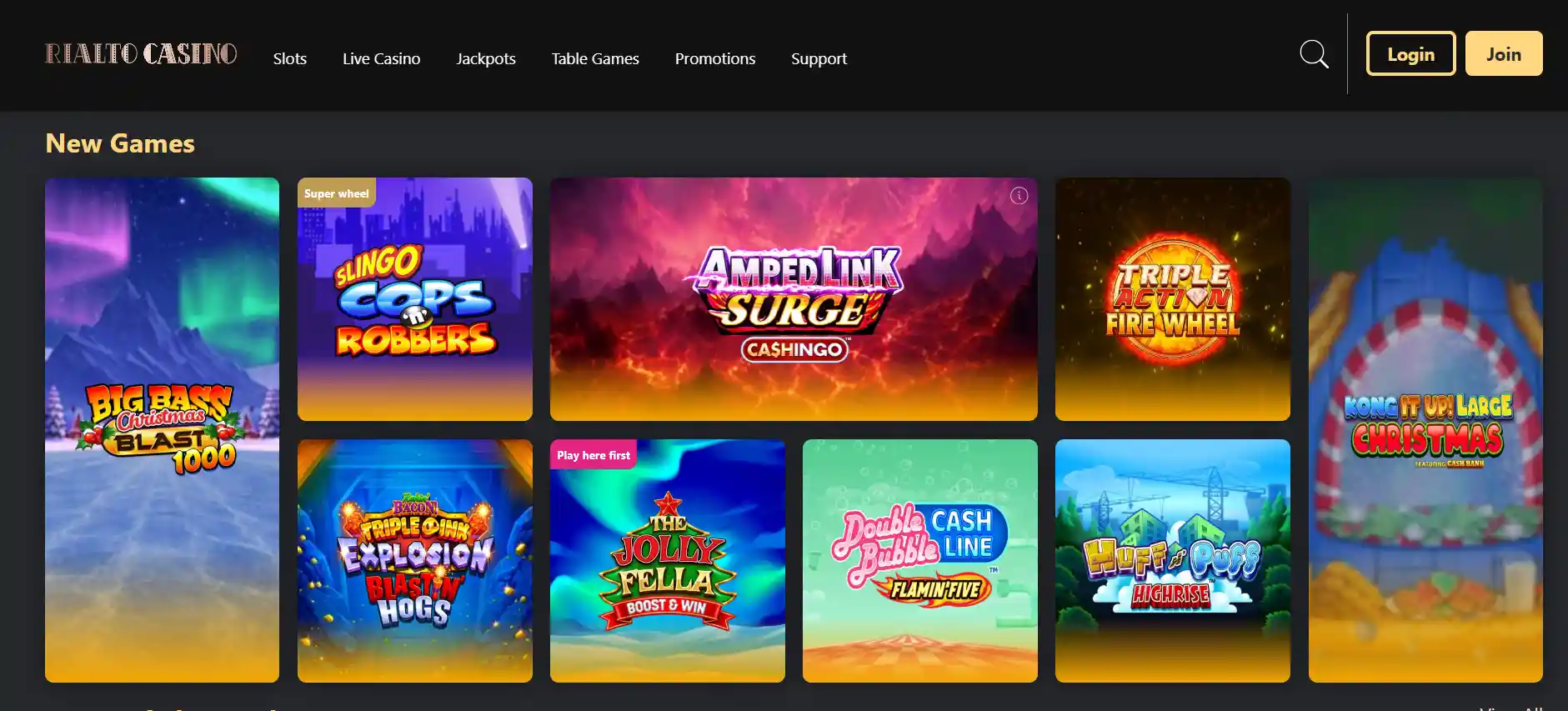
Table of Contents
- RTP and volatility change the meaning of a game choice
- Live tables, streamed venues and hosted game shows
- Software suppliers explain much of the catalogue's variety
- Jackpot King, King Millions, Mega Jackpots and WowPot
- From classic reels to Megaways and scratch formats
- Questions about the Rialto games catalogue
- How Rialto's game breadth translates into choice
RTP and volatility change the meaning of a game choice
Return to player, usually abbreviated to RTP, describes the mathematical proportion of stakes a particular game is designed to return over a very large number of rounds. It is not a statement about the next spin, a promise about a session or an amount a customer can redeem. At Rialto, game-specific theoretical RTP information belongs to each title’s help or rules. The relevant percentage therefore comes from the selected game, not from a headline number attached to the entire casino.
Two slots can look similar on a lobby screen while assigning very different probabilities and pay distributions to their outcomes. Some feature frequent modest returns; others reserve a greater share of the prize distribution for rarer events. This distribution is commonly described as volatility or variance. A session with a high-volatility game can move sharply in either direction even when its theoretical RTP resembles that of another title.
Consider two hypothetical games with an identical long-run return. One returns small prizes regularly; the other produces long gaps punctuated by occasional large awards. Over a short session, the player of the second game may see far more losing rounds. Equal theoretical return therefore does not imply equal experience, equal waiting time for a win or equal cash remaining after a set number of spins.
House edge is the opposite side of the same long-run calculation: it is the portion of total wagers the game is theoretically designed to retain. What matters for spending is total stake turnover. A fixed stake repeated many times creates repeated exposure, including after small wins are recycled into further play. A balance can show intermittent increases while the cumulative amount staked becomes much larger than the initial deposit.
Reading a game’s help panel before evaluating its features
- Find the exact game title and variant; similar names can have different specifications.
- Read the rules for paylines, bonus triggers, side wagers and the theoretical return shown for that version.
- Identify whether any jackpot or optional feature changes the main game’s return calculation.
- Set a session spending ceiling that does not depend on a hoped-for bonus round or jackpot.
A named slot in a promotion, such as Big Bass Hold & Spinner, has promotional restrictions that sit alongside its game rules. The welcome-spin wagering terms determine what bonus winnings can be used for, while the game help explains the underlying mechanics. Mixing those two sets of rules risks mistaking a qualifying wager for a guaranteed prize.
Live tables, streamed venues and hosted game shows
Beyond spinning reels, Rialto offers live roulette, blackjack, baccarat, casino poker and presenter-led game shows. The live section contains more than one production format. Conventional live-dealer tables present an ongoing table game, while game shows add a presenter and additional rounds, modifiers or wheel-based events. The differences are material because game flow, side options and the time between bets are not the same.
The distinctive Live & Direct format features casino tables broadcast from physical Grosvenor venues in Great Britain. That adds a different setting from a purpose-built studio. The table is still viewed through a screen, so a customer participates remotely and remains subject to the online game’s rules. The recognisable venue backdrop should not be mistaken for a change in the underlying odds or a promise of greater player control.
Roulette centres on wheel and number wagers. Blackjack involves player decisions within a defined set of rules, so a table’s particular rule set can affect the theoretical house edge. Baccarat has its own selection of bets, and live game shows use formats that need to be understood individually. None of those games shares a single meaningful casino-wide RTP.
Table pacing matters for budgeting. A hosted round can encourage successive decisions, while waiting for other table participants can slow the sequence. A slower game does not remove loss risk, and a faster one can increase the number of wagers during the same period. The important quantity is how much has been staked, not how cinematic the stream appears.
The dedicated Live & Direct and live casino guide examines the venue-stream format, named table categories and game-show structure in detail. Here, live play belongs alongside slots as a separate set of rules and rhythms rather than as one more reel-game category.
- Live roulette: wheel outcomes and bet layouts.
- Live blackjack: player actions, table rules and hand pace.
- Live baccarat and casino poker: distinct table formats and payout conditions.
- Game shows: hosted events with their own round structures and paytables.
Software suppliers explain much of the catalogue’s variety
The Rialto catalogue draws on multiple suppliers, including NetEnt, Novomatic, Microgaming/Apricot, Scientific Games, Pragmatic Play, Evolution Gaming, Blueprint Gaming, Play’n GO, IGT and Red Tiger. Their presence helps explain why the lobby includes conventional reel games, more intricate video slots, jackpots and live formats rather than a single production style.
A supplier name is a useful way of understanding who developed a game, but it is not a substitute for reading that game’s rules. Companies publish different titles with different mechanics, paytables and degrees of complexity. Even within the same supplier’s portfolio, one title might be a straightforward slot while another uses additional bonus stages and unusual reel structures.
| Catalogue reference | Relevant format | What to examine |
|---|---|---|
| NetEnt, Red Tiger, Play’n GO, Blueprint Gaming | Video and feature-rich slot libraries | Reel structure, bonuses, RTP and volatility for the specific title |
| Novomatic, IGT, Microgaming/Apricot | Traditional and video-slot portfolios, including jackpot-style games | Base game rules and whether a separate jackpot mechanism applies |
| Pragmatic Play, Scientific Games | Broader casino-game software portfolios | Actual game category and published rules rather than supplier identity |
| Evolution Gaming | Live-dealer and hosted game-show production | Table rules, pace, side bets and show-specific paytables |
The table describes the kinds of work associated with recognised suppliers, not a claim that every game in each supplier’s entire library is carried by Rialto. The individual title selected in the lobby determines what is actually available and which rules apply.
It also helps to distinguish a game’s software creator from its visual theme. A colourful animated screen can make a game seem unusual, yet its wager mechanics may be quite standard. Conversely, a familiar-looking slot may hide a variable reel count, a bonus buy mechanic in markets where offered, or a different award structure. Those differences must be identified from the game controls and instructions.
Rialto’s range is large enough to merit browsing by category before browsing by supplier. That gives the player a better chance of comparing like with like: slots against slots, live table games against other tables, and feature games against titles using comparable bet structures. It also prevents a provider’s reputation from being taken as a numerical estimate of any one game’s return.
Jackpot King, King Millions, Mega Jackpots and WowPot
Rialto’s jackpot catalogue includes the families Jackpot King, King Millions, Mega Jackpots and WowPot. These are useful names for locating jackpot-bearing games, but the family name on its own does not tell a player the precise jackpot contribution, trigger or probability for a particular title. Those properties must be read in the game’s help materials.
Jackpot prizes introduce another layer beyond ordinary base-game payouts. Some jackpot systems build a prize pool over time; others use differently structured fixed or linked awards. A growing prize amount can become the most visible information on the screen, even though the event required to obtain it may be rare. The published headline prize is not a measure of how often it will be won.
Different jackpot families can also have different rules for eligibility. The required stake, trigger mechanism, contributing game version and payout structure may matter. An optional side wager in one game does not establish that a side wager exists in another. A customer therefore needs to inspect the exact help screen before assuming the same jackpot applies across every game carrying a familiar family name.
The three numbers a jackpot banner should not be confused with
- Displayed jackpot amount: a prize figure that may belong to a particular linked pool or event.
- Probability of winning: a of the relevant game or jackpot mechanism, distinct from prize size.
- Expected spending: affected by stakes, how often rounds are played and the game’s actual return mechanics.
A large first number supplies no direct answer to the second or third. The eye-catching jackpot remains a low-frequency possibility rather than a sensible basis for a spending plan. Losses on unsuccessful rounds are real even when the prize has not been triggered, and the game can continue long after the initial deposit has been wagered through once.
Jackpot-themed games also appear alongside regular video slots. Comparing them usefully means looking at the ordinary game first: base-game stake, paytable and feature rules. The jackpot should be treated as a separate mechanism whose conditions can materially change the way wagers are exposed.
From classic reels to Megaways and scratch formats
Rialto’s slot selection extends across classic slots, video slots and Megaways-style titles, with separate access to jackpot games and scratch-style content. Each format can encourage a different playing rhythm. The category label identifies a general design approach, but it does not determine a fixed return or a fixed level of risk.
Classic reels often put the emphasis on familiar symbols and simple visible patterns. Video slots can add multiple paylines, animated sequences, hold features, bonus rounds or more complicated prize evaluations. Megaways games vary the number of symbol positions or potential ways to win from spin to spin. That changing layout can make results feel varied even when the game’s mathematical specification remains fixed for the selected version.
Scratch-style games present results through a different reveal mechanic, but the same distinction between stake, payout probability and long-run return still applies. A short reveal is not inherently lower risk. It may simply make rounds easier to repeat. Game shows and live roulette are separate categories because their outcome generation and decision pace have different structures.
A practical comparison is easiest when the questions are asked in a consistent sequence:
- What is the actual stake per round, including any optional feature or side wager?
- What determines a win, and what happens when a bonus feature is triggered?
- Where does the particular game explain its theoretical return and paytable?
- How many rounds could fit into the spending boundary set for the session?
Rialto also provides a native Android app and mobile browser play. A narrow phone display can condense controls and game-help information, so understanding the full wager value matters there as much as on desktop. The mobile play guide covers the Android and browser formats, while the main Rialto overview places the games catalogue alongside payments, player controls and customer feedback.
It is sensible to treat each game as a separate set of terms. The provider list helps navigate the library, the category helps anticipate the interaction, and the paytable is what defines the bet. None removes the fundamental uncertainty of individual results.
Questions about the Rialto games catalogue
What types of games does Rialto Casino have?
Rialto offers classic and video slots, Megaways-style games, jackpot slots, scratch games, live roulette, blackjack, baccarat, casino poker and hosted game shows.
Which jackpot families appear at Rialto?
The catalogue includes Jackpot King, King Millions, Mega Jackpots and WowPot. Each title's own jackpot rules determine how an award can be won.
Does one RTP figure apply to every Rialto game?
No. Theoretical RTP is game-specific, and the relevant figure and rules should be checked for the exact title being played.
Are Rialto's Live & Direct tables streamed from physical venues?
Yes. Live & Direct includes table broadcasts associated with physical Grosvenor casino venues in Great Britain, alongside other live-dealer and game-show formats.
Does a large jackpot make a game more likely to pay?
No. The prize amount and the probability of triggering it are separate properties. A large displayed award does not guarantee a win or a particular return during a session.
How Rialto’s game breadth translates into choice
Rialto’s catalogue is broad across three genuinely different experiences: software-driven reel games, jackpots with their own award mechanics, and live tables including venue-streamed roulette. Names such as Red Tiger and NetEnt help orient the slot selection, while Live & Direct makes the table offering more distinctive than a lobby limited to studio broadcasts. Those are differences in format and presentation, not evidence that any particular game is more likely to return a player’s money.
The strongest comparison starts with a precise game and its rules, then examines the rate of play and the total amount staked. A jackpot label does not replace probability information; a branded supplier does not replace a paytable; a live venue does not replace a spending limit. The catalogue offers variety, but its mathematical risks remain attached to each wager. A deliberate session limit and a willingness to stop when that limit is reached matter more than switching among categories in search of a guaranteed outcome.